The code was my memory

I’ve always had notes systems to help me forget; to help me brain dump and free my own context. That’s ever been important as a person with ADD, even before I knew that ADD was the reason it was important. Chronicles or any note application that works like it is an essential partner to how I’m able to work; to remember and act on my ideas over time.To effectively discard the ones I don’t need right now. Notes app, notebook, a pen and the back of my hand. Whatever. Any way I can jot stuff down in an unorganized fashion helps.
But lately I’ve been thinking more about Wiki’s, something I thought little of before. Unlike my chronological notes, Wiki’s are less about offloading and more about organizing concepts into a mental model. It’s more than a reference or garden. The most immediate analogue I have is from my prior life. I’m reminded of how in medical school, when I would have to learn things so deeply and across so many subjects, that I found myself sort of memorizing entire books, and it felt hard to fit it all into my brain. I found my mind offloading parts of my (longer term) memory, so when I needed to recall certain facts, I would know oh X fact is around this page in my neurology book; and I would be able to quickly find or confirm the information I needed. It was more like an anchor for my memories and I’m sure this is well studied. Wiki’s to me work similarly. It’s not just about organizing; its not performative productivity. It’s about building a representative model of what a project is; what this group of related concepts means and how together there is a cohesive story. Organizing the information in the wiki also organizes it in your brain.
It’s also really an excellent way to inject context into a LLM session when you want to do work related to the project(s) a wiki describes. You can use a wiki index as a starting point for a chat, then the LLM has a mental model that matches your mental model and you can skip the “what I’m about to ask about” ceremony.
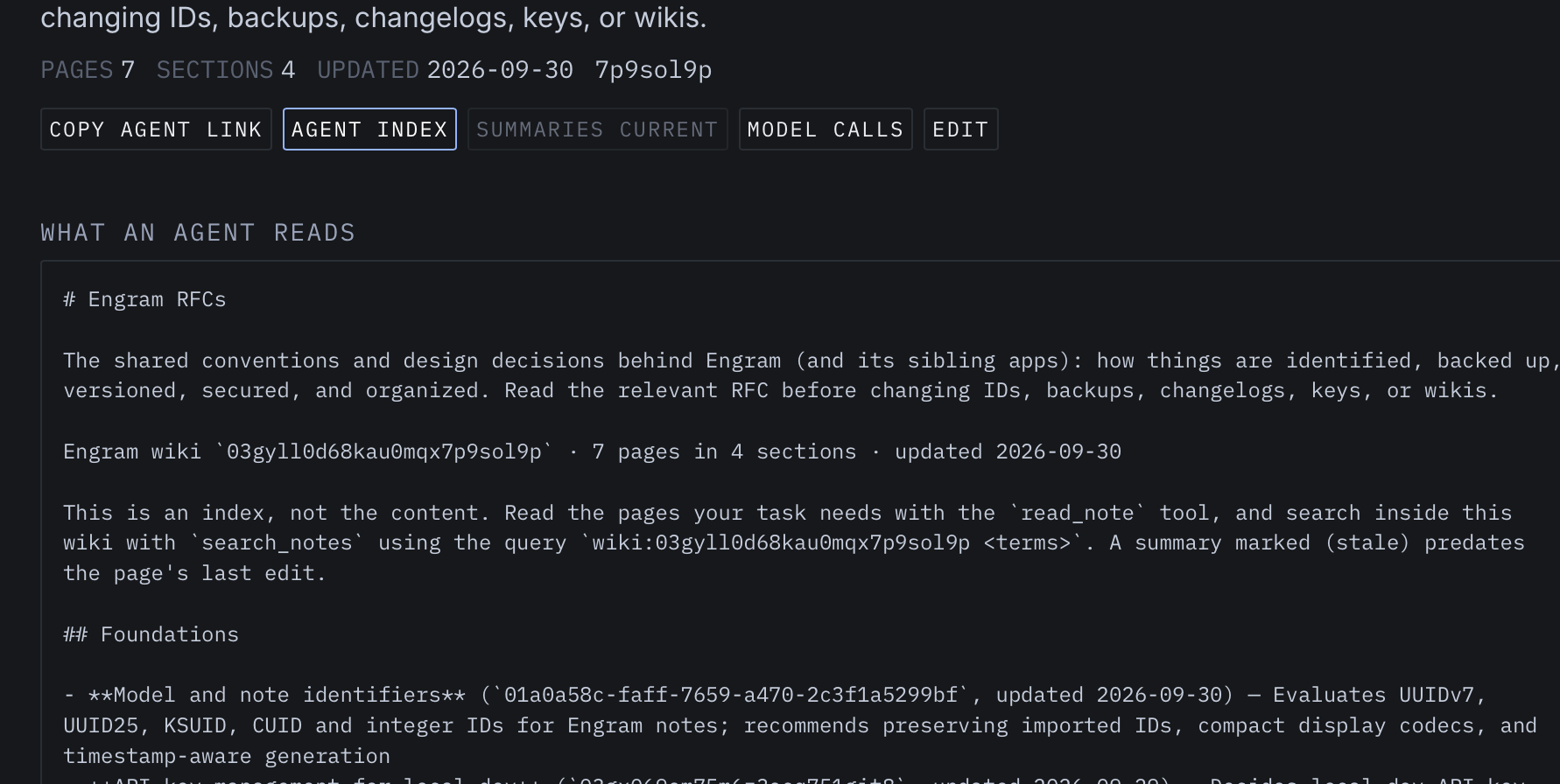
I’ve been struggling a lot at work thinking about how to keep track of things and while I’ve always needed something like a wiki, I’ve never felt I needed it so bad as now. I hear myself say its because I’m blowing through so much information, and I think that’s a popular narrative; an appealing one even. But I realized - or think - there’s something else.
It reminds me of my other note on typed code and add where I thought about how I liked using typed programming languages better than untyped ones because when I thought in terms of types and interfaces, I was able to offload my working memory onto the type system and through it have more complex and organized thoughts that I could have with untyped code, or frankly with words alone.
Now I find my thoughts back there again, but in a different way. The reason that I can’t figure out the right kind of wiki system to use or what to put in it and what not is because what’s really missing isn’t the wiki. It’s the hole(s) in my brain where the code base(s) used to be. I would work on one or a limited set of code bases over a long period of time and your brain starts to meld with the code. You know where things are, but it’s more than that. Your brain offloads, how certain things work to different parts of the code base. If I need to know the details I know where to look in the codebase; I don’t need to keep the details in my head. I can get to them quickly and because it’s code, it will be precise and well organized, and when you’re lucky elegant even. Layered abstractions where you can continuously peel back as you need more details but if you need less you stay higher. I don’t think that there really is a wiki or any form of prose that can match that level of fidelity; that can match that level of efficiency you get.
There’s this idea that code is going turn into how compilers were with machine code, which is now just this thing that very few ever look at and most never need to look at again. Or even know how it works. And that we’re free from it and can all move faster without it.
I’m not sure I think that’s true. I think that I’m missing something that I can’t get back without the code and I’m not sure that that means that I need to memorize the code base as it was before or not. Its not like I’ve forgotten how to code; at this point in my career I’m not even sure that would be possible to do. I think it’s more that code, in some respects, already was the highest level of abstraction you could get to to have that kind of deep, structured thought, and if that deep structured thought is what you’re after or what you need to do something complex then I wonder if or when we have to get back to thinking in terms of code for it to ever be effective. Or as effective, as it was.